
Research Colloquium Summer Term 2026
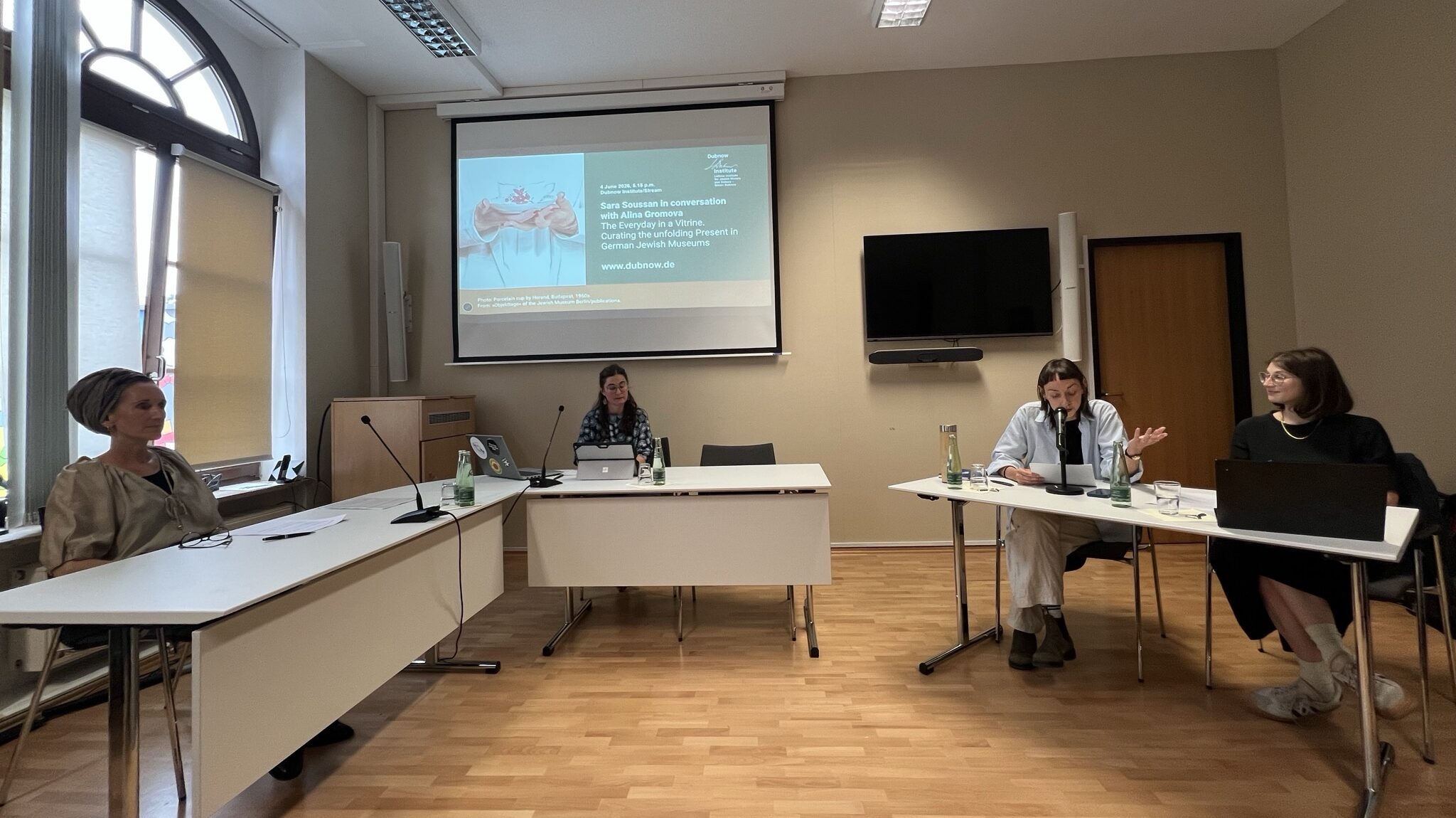
The third session of the research Colloquium Passing Through Hands: Objects in Jewish Everyday Lives, organized by the Dubnow Institute in cooperation with IRTG Belongings, differed conceptionally from the first two wonderful evenings. On June 4th 2026, a dialogue by two lectures was followed by a large audience.
Katarina Rakić welcomed the audience wamrly to this session about curating as a practice of documenting, transforming, selecting, disturbing and interpreting. She introduced Alina Gromova, who worked certain years in Jewish museums in Berlin, Munich and is now teaching Museum theory and strategy, history of museums, museological theories, and collection devolopment at the HTWK Leipzig. Laura Schilling then introduced Sara Soussan, who has a background in Jewish education before becoming a curator at the Jewish Museum in Frankfurt. Soussan is deeply engaged in her work at the museum with questions concerning a presentation of the present in museological contexts.
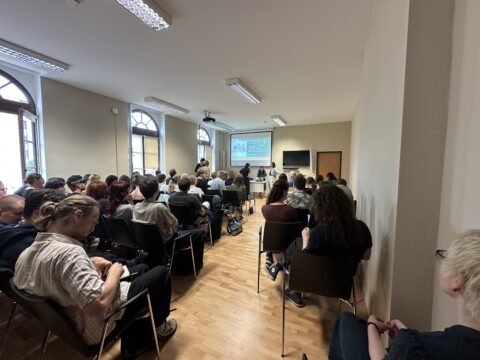
Photo by Thekla Funke
The first lecturer Alina Gromova offered her theoretical and metholodoical knowledge, while Sara Soussan guided as through the practices of collecting and curating in her everyday experience and the exhibitions at the Jewish Museum Frankfurt. The wonderful experience having two experts in the room really came to life when the two lecturers presented their different approaches concerning the questions they were raising in their work: while Soussan focused on Jewish identities and belongings in her museological practice, Gromova questions the connections of people and Jewish Museums. The challenges for institution of museums in the digital age were adressed and questions of temperorilaty raised. Soussan introduced the practice of handling material and digital objects in a present in the Jewish Museum Frankfurt and how multi-layered objects become over time.
After a lively discussion between the Alina Gromova and Sara Soussan, the audience asked several questions. During this session, questions about the interaction with Jewish communities after 1945 and the museum’s responsibility in preserving and narrating objects came up. Both museologists underligned the importance of the museum as a space where people come together. In this sense, an exhibition is not only created with knowledge from research but contains emotional stories from people’s memory about certain objects.
The two perspectives—one theoretical and one practical—presented by the lecturers complemented each other very well. At the same time, they highlighted the boundaries between what can be constructed theoretically and what is achievable in everyday museological practice.
Text by Thekla Elise Funke and Lena Sophie Voss