
Research Colloquium Summer Term 2026
The fourth session of the Research Colloquium Passing Through Hands: Objects in Jewish Everyday Lives, organized by the Dubnow Institute in cooperation with the IRTG Belongings, took place online and featured a lecture by visual artist Talia Tokatly, who joined from her home in Israel. Noa Miro supported the event on site by assisting with technical matters and, where necessary, translation from Hebrew into English. The event was opened and moderated by Carolin Heymann-Serota, who introduced Tokatly’s extensive artistic career and situated the lecture within the broader framework of the colloquium.
Talia Tokatly (b. 1949, Tel Aviv-Yafo; lives and works in Mevasseret Zion and Abu Ghosh) is a sculptor, ceramicist, and installation artist, and a graduate of the Ceramics Department at the Bezalel Academy of Arts and Design in Jerusalem. Having taught in the Department of Ceramics and Glass Design for approximately three decades, she is also the editor of 1280°, an Israeli periodical dedicated to material culture. Her work has been exhibited widely in Israel and internationally, and she was most recently awarded the Israeli Ministry of Culture’s Arik Einstein Award for Senior Artists in 2024.
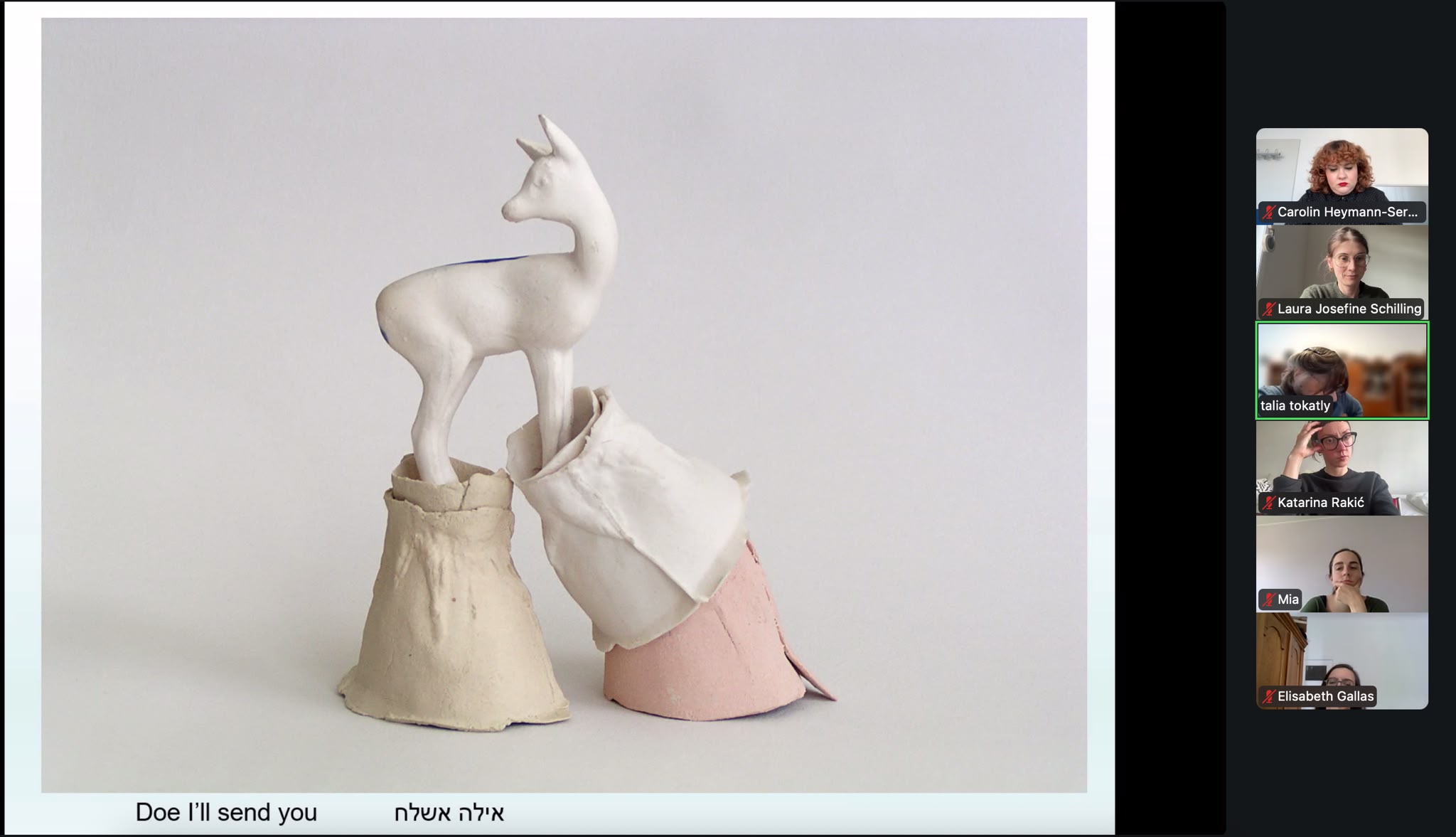
Screenshot of Talia Tokatly’s presentation
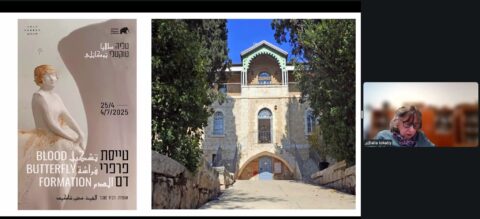
Structured in three parts, the lecture combined visual presentation with reflective commentary, tracing the development of Tokatly’s artistic practice up to her most recent exhibition, Blood Butterfly Formation (Mamuta Art and Research Center, 2024). Throughout, she presented images of her works, offering insight into both artistic process and conceptual framing.
In the first part, Tokatly situated her engagement with objects and furniture within a deeply personal and familial context. As a child, she encountered a shipment of furniture and domestic items sent from her father’s former home in Vienna – a home he had left briefly before the Second World War, while much of his family and social world was subsequently destroyed. These objects became a formative point of departure for Tokatly’s artistic imagination, sometimes being able to think and speak before she herself could. This capability of objects to assist her in posing and answering questions became more visible with each slide Tokatly showed in her presentation.
Building on this foundation, Tokatly discussed Blood Butterfly Formation as an installation that transforms domestic space into a network of materialized memories, emphasizing the objects’ capacity to carry and reconfigure memory across contexts of migration.
A central conceptual thread of the lecture was Tokatly’s engagement with trans-generational memory. Drawing on the notion of epigenetics, she proposed an understanding of memory that exceeds direct experience, suggesting that traces of the past are transmitted, embodied, and reworked across generations. Tokatly further explained the crucial role of the notion of epigenetics in her work. Borrowed from the field of Biology, epigenetics allows Tokatly to transmit the changes occurring to objects not within themselves (their DNA metaphorically speaking) but by external environmental or psychological factors impacting the genes. She illustrated this with the example of trauma experienced by a parent and passed on to the child. Trying to capture such a metamorphosis of migrant objects – which have gone under displacement and entered a new home – and the resulting alteration of their “genes” lies at the center of Tokatly’s art.
The lecture concluded with a discussion that addressed questions of materiality, artistic process, and the role of objects in negotiating histories of displacement between Vienna and Israel. The subsequent Q&A session allowed participants to further engage with Tokatly’s work and its implications for understanding everyday objects as carriers of trans-generational memory and as sites of continuous transformation. Tokatly shared how until today the question of passing on these objects when she is no longer there is occupying her – a question she continues approaching in her art.
Text by Katarina Rakić