
Research Colloquium Summer Term 2026
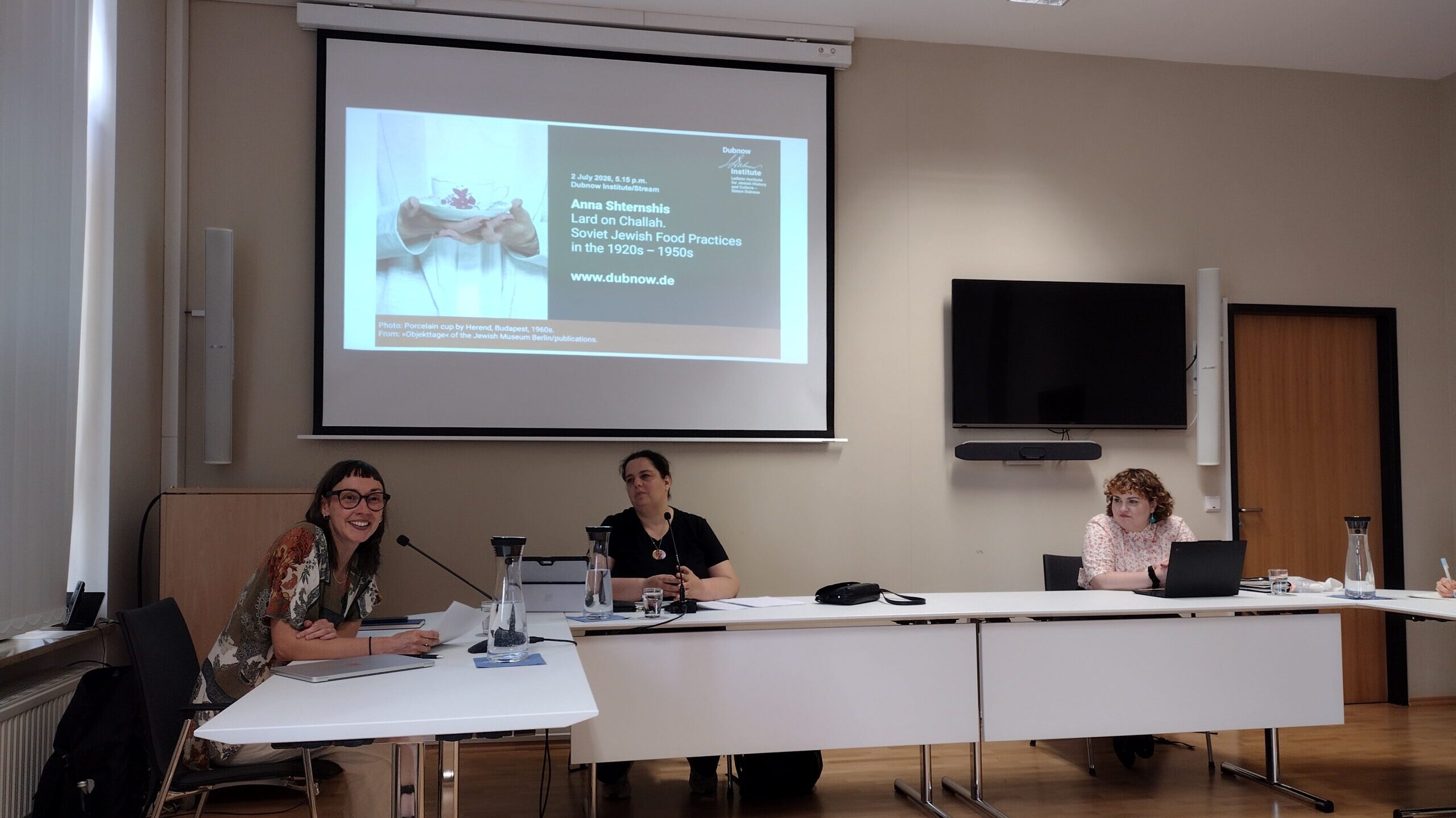
The series Passing Through Hands: Objects in Jewish Everyday Lives concluded on Thursday, July 2, 2026, with a wonderful final lecture. Organized by the Dubnow Institute in cooperation with the IRTG Belongings, the research colloquium brought together five stimulating sessions throughout the semester. The concluding lecture, Lard on Challah. Soviet Jewish Food Practices in the 1920s–1950s, was delivered by Anna Shternshis. Katarina Rakić introduced the speaker by highlighting Shternshis’s work integrating fields such as oral history, literature, and poetry to offer original perspectives on popular culture of Soviet Jewish life.
Drawing on her oral history project conducted primarily in Germany with Jews born in the Soviet Union before the 1930s, Anna Shternshis demonstrated how food emerged as a central theme in the interviews, despite not being part of the original research focus. She explained that memories of food often triggered broader recollections and emotions, providing a unique lens through which to examine Soviet Jewish history. The stories she collected illuminate the complex interplay between personal, collective, and state narratives while touching on themes such as family life, celebration, identity negotiation, ‘assimilation,’ everyday life under totalitarianism, famine, war, loss, and cultural continuity.
Throughout her research, Shternshis observed that constructing life stories through food memories is often closely connected to understanding what it means to be Jewish. One interviewee’s complaints about her husband, for example, became intertwined with the memory of sending him dumplings with cherry syrup during his time in the army. While her description of preparing the dumplings was embedded in accounts of discrimination, conflict, and hardship, she viewed the recipe as a symbol of Jewish identity, distinguishing the family’s traditions from those of their non-Jewish surroundings.
Photo by Oliver Krause
Approaching oral history as a literary scholar, Shternshis argues that every story possesses a genre and structure. She reads the story of the cherry dumplings as a quest narrative, in which the narrator seeks to ensure her husband’s success in a hostile society. Similar patterns emerged in other interviews, where preparing food for non-Jewish colleagues or guests reflected attempts to gain acceptance, shedding light on the persistence of antisemitism in this context.
Food memories additionally offer valuable insights into family relationships and gender roles. Mothers and grandmothers, Shternshis noted, were frequently remembered through the food they prepared, regardless of whether these memories were positive or negative. Striking in this context was Shternshis’s observation that many participants switched to speaking Yiddish when recalling foods from their childhood. Many interviewees also recalled associating kosher food with the older generation during their youth, making food an important marker of generational shifts and of the negotiation between tradition, modernity, and nostalgia.
Following Anna Shternshis’s lecture, the audience engaged in a lively discussion moderated by Carolin Heymann-Serota and Laura Schilling. Questions explored further the circumstances of the interviews, relations between different Jewish cuisines, the role of humor in storytelling, and the connections between food, compromise, and social mobility. Elisabeth Gallas concluded the event by thanking the organizers of this semester’s research colloquium and encouraging the audience to follow the Dubnow Institute’s future activities and upcoming lecture series.
Text by Ines Gerber